Music
Discover how the school's Music programme builds skills in singing, playing instruments, and music appreciation across all six primary years.
Music
The General Music Programme (GMP)
The General Music Programme (GMP) enables our students to listen, sing, dance, play and express themselves musically. The GMP aims to:
a. develop awareness and appreciation of music in local and global cultures
b. develop ability for creative expression and communication through music
c. provide the basis to develop an informed and life-long involvement in music
The Learning Objectives (LO)
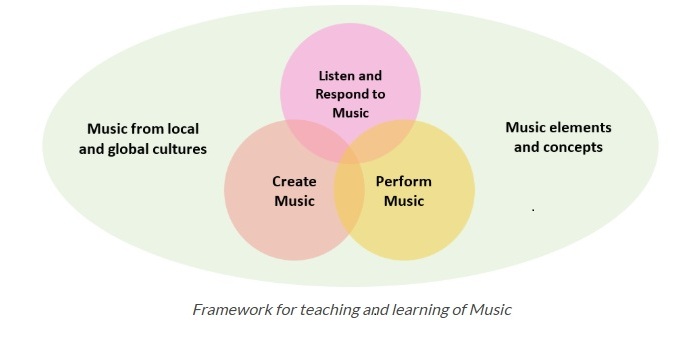
The learning outcomes are organised around five Learning Objectives (LOs). All learning outcomes are addressed and learned in an integrative manner, where elements and concepts are learned through active musical experiences, such as music creation and performance as well as movement in music; and where the display of musical skills (listening, creating, performing), draw on students’ learning and understanding of musical elements and concepts.
LO1: Perform Music in both instrumental and vocal settings, individually and in groups
LO2: Create Music in both instrumental and vocal settings, individually and in groups
LO3: Listen and Respond to Music
LO4: Appreciate Music in local and global cultures
LO5: Understand musical elements and concepts
Curriculum Mapping for Music
Throughout the six years in school, students go through the following programme:
Music Program
Term 1 | Term 2 | Term 3 | Term 4 | ||
Primary 6 | Music Carousal | Ensemble | |||
Primary 5 | Singing | Ukulele | |||
Primary 4 | Recorder | ||||
Primary 3 | Keyboard | ||||
Primary 2 | Resonator Bars | ||||
Primary 1 | Non-pitched percussion | ||||
An overview of the Music curriculum in school.
Singing (Engaging with songs - EWS)
Playing in an ensemble promotes Social Emotional Learning (SEL) with opportunities that allow students to experience values in actions, thus making Character & Citizenship Education (CCE) comes alive. It empowers students to shape their musical identity and self-concept, builds quality relationships within the musical groups, and generates agency or self-directedness and personal responsibility in the musical choices the students make.
Instrumental studies
The GMP offers a variety of instrumental studies to enhance the musical engagement of our students. Music creating processes harness and develop students’ innate creativity within the context of music. Through musical activities such as improvisation and music composition, students will apply the musical skills and concepts that they have acquired through listening and performing, thus drawing a connection and relevance to all that they are learning.
Ensembles
Playing in an ensemble promotes Social Emotional Learning (SEL) with opportunities that allow students to experience values in actions, thus making Character & Citizenship Education (CCE) comes alive. It empowers students to shape their musical identity and self-concept, builds quality relationships within the musical groups, and generates agency or self-directedness and personal responsibility in the musical choices the students make.
Music Appreciation
Music plays a vital role in almost all cultures and societies. Through a wide exposure to music from both local and global cultures from a young age, students will be able to gain insights to other cultures and be open to the different types of music available. They will understand the different roles musicians play in society as well as the role of music in different cultures. It is through this knowing about the music, its musicians, its role, and value in culture, that musical understanding is deepened and contextualized for the students.
Music appreciation comprises the music appreciation lessons via Student Learning Space (SLS), the 24 songs from the Indicative Repertoire (IR24) as well as through a school-wide arts appreciation programme, Morning Melodies.
Music Appreciation Lessons (via SLS)
A series of 18 lessons were designed by the music teachers to engage students in the appreciation of music. The lessons support the Music, Art, and Dance curriculum. Each level addresses a cultural focus, including relevant vocal traditions and instrumental studies from various cultures. The lessons serve to introduce students to the role of music in respective performing arts from each culture, such as ensemble, dance, and theatre.
The table below describes the targeted cultures and regions based on the MOE Music syllabus. This is aligned to the skills and concepts from the Music scheme of work.
Music Appreciation Lessons by primary level and cultural focus
Cultural focus | Vocal Traditions | Instrumental Studies | Music in the Performing Arts |
|---|---|---|---|
Primary 6: | Japanese Enka | Japanese Shamisen | Gagaku ensemble, Kabuki, Korean Talchum |
Primary 5: | Songs from Oceania | The Didgeridoo | Hawaiian hula, Aboriginal Joonba, Ori Tahiti |
Primary 4: | Swara | Ghungaroo, Tabla | Carnatic ensemble, Koodiyattam, |
Primary 3: | Asli Malay song | Cek Lempong, Kompang | Dikir barat troupe, Wayang kulit, |
Primary 2: | Chinese operatic singing | Strings 弹拨,拉弦 | Chinese Orchestra, Beijing Opera 京剧, bian lian 变脸 |
Primary 1: | Arias | Strings and Woodwinds | Western classical orchestra, |
An overview of the skills and concepts taught in the Music curriculum
Indicative Repertoire (via SLS)
A set of SLS lessons based on the Indicative Repertoire was created and launched in 2022 to enhance the appreciation of music from the Singaporean culture. Through the experiences with Singaporean folk songs, national and community songs, students can identify, sing, and talk about the role of these songs, thus developing a deeper appreciation of the cultural music and instruments in the local context.
Each SLS lesson includes a music video with lyrics to ease the learning of the songs, facts, and trivia about the songs, as well as informative links to enhance and extend the learning.
Morning Melodies
Morning Melodies is part of the school’s arts appreciation initiative, Arts Alive!. The pre-assembly programme aims to enhance music appreciation at a whole-school level through the introduction and exposure of our students to extra-curricular musical knowledge. It raises awareness to the nuances of music listening which includes festival music, popular and Classical music, as well as musical groups, composers and songwriters. It serves to highlight the values, in line with our CCE framework.
By learning about musical facts, students develop and extend their appreciation of music to greater depth. This encourages them to listen and think beyond the mere consumption of music.
Music Resource Website
Since 2019, the Music Makers has been established as part of the Lifelong Learning Programme (Creative Arts). The enrichment programme builds on skills and concepts the students encounter in the MOE music curriculum. Besides ensemble singing and instrumental skills, students also participated in various performance opportunities within and beyond the school.
The experiences aim to build confident performers and to equip them with skills in preparation for musical Co-Curricular Activity (CCA) in Primary 3. Through this year-long programme, our Music Makers develop greater curiosity and take greater ownership in their own learning.
Talent Development Programme
Since 2019, the Music Makers has been established as part of the Lifelong Learning Programme (Creative Arts). The enrichment programme builds on skills and concepts the students encounter in the MOE music curriculum. Besides ensemble singing and instrumental skills, students also participated in various performance opportunities within and beyond the school.
The experiences aim to build confident performers and to equip them with skills in preparation for musical Co-Curricular Activity (CCA) in Primary 3. Through this year-long programme, our Music Makers develop greater curiosity and take greater ownership in their own learning.